RSS Feed

9/30/2016

Topic Reading-Vol.1633-9/30/2016

Dear MEL Topic Readers,
6 great secrets from the Trans-Siberian railway
This probably is the most famous railway in the world, for the last 100 years.
Yes, the Trans-Siberian railway was completed a year before the Russian Empire collapsed during the World War I. The most notable passenger of that time was then Tsar, Nicholas II, who was abdicated and later executed during the Russian Revolution.
It is famous for the original line between Moscow and Vladivostok passing along Lake Baikal, the deepest lake in the world that sits north of the Mongolian border. Those who took this train ride often mention that seeing this beautiful lake from the train was a once-in-a-lifetime experience.
But there are lesser known railway routes that travel Siberia. One goes to through Manchuria to Beijing from the lake and another through Mongolia. Passengers of these lines can experience trans-cultural places and scenes from the train.
Enjoy reading the guide and seeing the photos of this 100-year-old railway.

9/29/2016

Topic Reading-Vol.1632-9/29/2016

Dear MEL Topic Readers,
Zuckerberg and Chan aim to tackle all disease by 2100
The couple already committed to donate 99% of their Facebook shares to fund good causes when they had their first baby girl. Now they revealed a bold and ambitious plan to make use of the fund. They are investing three billion dollars to cure, manage or prevent all diseases before the next century.
Even though the amount isn’t that significant compared to other causes and researches trying to deal with just certain diseases, such attempt to transform medical solutions is in line with other philanthropists, including Bill & Melinda Gates Foundation.
Also, there is AI, which is transforming the ways that business, service, operations, and even research and development have been conducted into the next stage. It seems that this century is going to produce a lot of revolutionary changes and transformations.
Enjoy reading and thinking which common disease should be conquered first.

9/28/2016

Topic Reading-Vol.1631-9/28/2016

Dear MEL Topic Readers,
A city without traffic lights
The city doesn’t look modern at all. Rather, it looks either very ancient or futuristic. There aren’t any tall buildings or highways. It spreads out with eight main roads from the central square in a very organized fashion, forming an octagonal shape.
One distinctly unique feature of this remote city in Northwest China's Xinjiang Uygur autonomous region is there are no traffic lights. Is that because there aren’t so many cars on the roads, people drive so decently that there is no need for traffic control, or there is no electricity or budget to lit traffic lights?
Enjoy reading and seeing the photos of this remote but well-organized city in Uygur.

9/27/2016

Topic Reading-Vol.1630-9/27/2016

Dear MEL Topic Readers,
France becomes first country to ban plastic cups and plates
Plastic disposable tableware. Sounds economical, convenient and hygienic but harmful to the environment, doesn’t it? It is so widely used all over the world that eliminating or reducing the use of plastic cups, plates, forks and spoons seems quite challenging.
But France is taking the lead. As the hosting country of the COP21 Climate Change conference in December 2015, it has set the way to reduce greenhouse emissions 40% by 2030 from 1990 levels. The country already banned the use of light plastic bags at supermarket checkouts in July, and now requires all disposable tableware to be made from 50% biologically-sourced materials by January of 2020.
This sounds environmentally friendly to ordinary citizens but economically and practically worrisome to those who produce, distribute and use them.
Whenever an ambitious initiative is raised, there is always backlash from someone.
Enjoy reading and thinking if disposable tableware is necessary in the first place.

9/26/2016

Topic Reading-Vol.1629-9/26/2016

Dear MEL Topic Readers,
What is the food that can really improve your eyesight?
Eat green leaves, not carrots, to improve your eyesight. That’s what the writer of this article recommends after being tested and advised by the experts. Yes, there are effective supplements out there that you can take to improve, or slow the process of losing, your eyesight. But the key elements of those supplements are mainly take from natural produces such as green kale and spinach, corn and bell peppers, or the yellow yolks of eggs and fish.
Yes, supplements work to help maintain or even improve your eyesight but proper diet also does. And that’ll get you extra benefit, better nutrition to improve your health.
Enjoy reading and learning what makes your eyesight better.

9/25/2016

Topic Reading-Vol.1628-9/25/2016

Dear MEL Topic Readers,
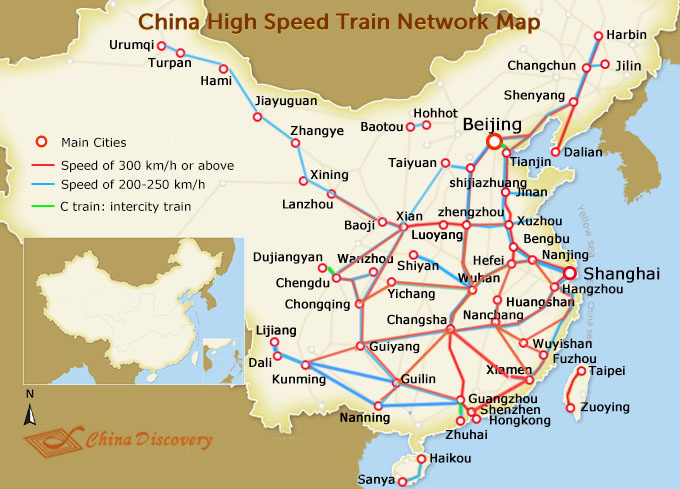
China's high speed railway exceeds 20,000 km
Just amazing. Look at this map.

It took China only less than 10 years to build this 20,000km high speed railway network, which is already longer than the rest of the world's high-speed rail tracks combined. And it is still expanding. Their plan is to build 40,000km network by 2025!

China already has built highways to cover most of the major cities. Its annual car sales exceed over 25million, easily surpassing the U.S. (#2) and Japan (#3) combined.
It is also expanding the air transportation capacity, ordering thousands of passenger airplanes for the next several years.
Why not taking advantage of this soon-to-be the world most accommodating country for travelers, at least for public transport?
Enjoy seeing the maps and thinking of what the country will be like a few years from now.

9/24/2016

Topic Reading-Vol.1627-9/24/2016

Dear MEL Topic Readers,
Jane Goodall's latest mission to save chimpanzees
Educate people to save chimps. That sounds a little odd, doesn’t it?
But when a once-forested area is inhabited and farmed without limitation or consideration to the environment, the area becomes uninhabitable for primates that depends their lives on the forest. Then they are divided to small groups that are sustainable enough to live in limited space where they can find food. But when the size of such groups becomes too small, they’ll face difficulty to maintain genetic and social diversity of the species. In order to protect the population of wild animals, humans need to learn what good not only for themselves but also for other inhabitants in and around the area.
That’s why Jane Goodall, a renowned primatologist and animal right activist, set up a micro-funding program to finance the poor farmers in Tanzania. When they earn more, women and children receive education. When they are educated, they become more conscious of their environment while, interestingly, shrinking their family size. Thus, the more forest could be protected, or at least less forest is destroyed. It’s a long way to achieve the goal but a surer way to save chimps.
Enjoy reading and thinking if there is any short cut to do things in a sustainable way.
http://edition.cnn.com/2016/09/12/world/iyw-jane-goodall-chimpanzees-microcredit-loan-program/index.html